

The Minimum Asset-Event Registry Model for Tokenization: Issue, Transfer, Pledge, Freeze, Redeem (and Required Fields)
If we can’t answer “what happened to this unit and when?” in one query, our token layer won’t save us.
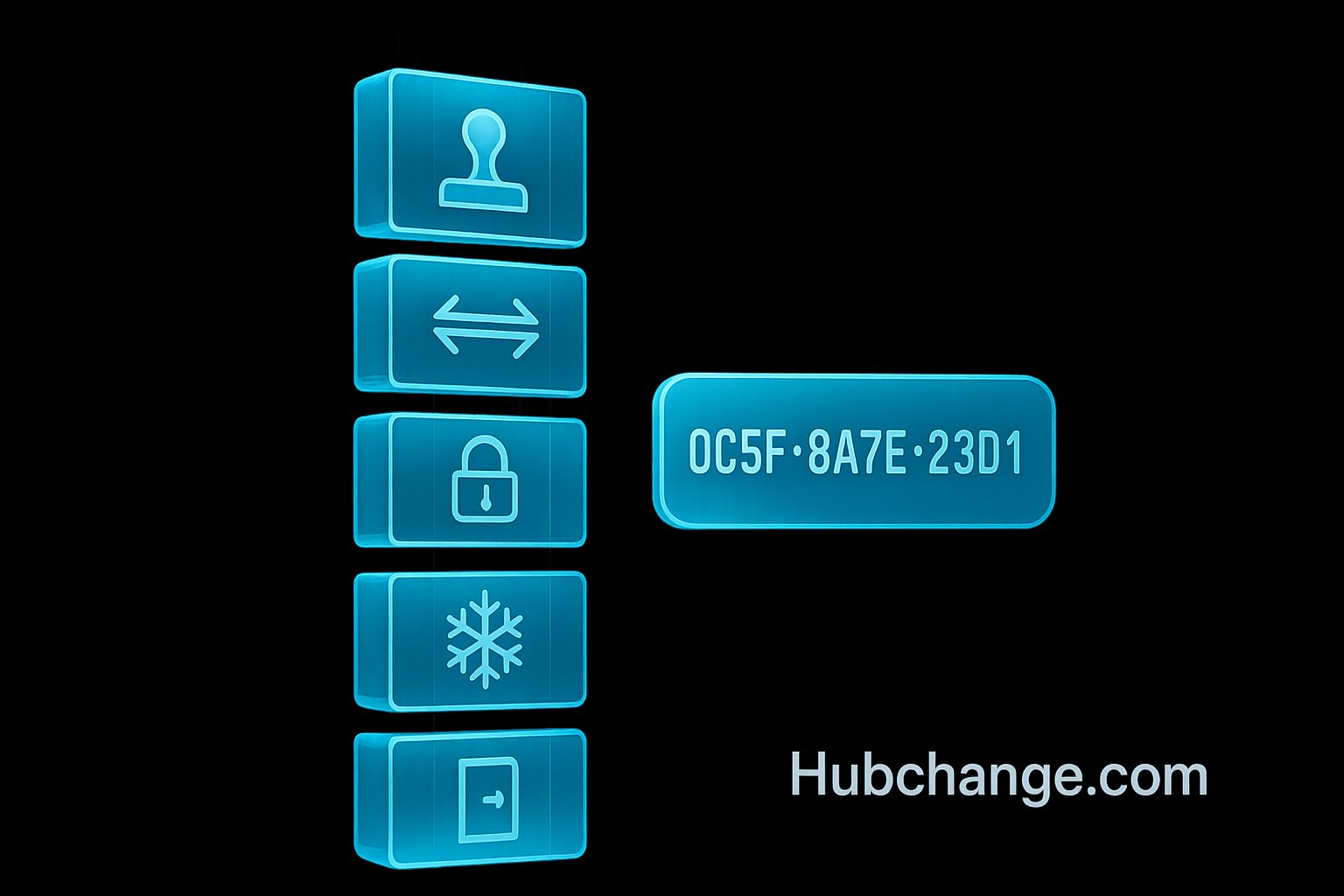

If we can’t answer “what happened to this unit and when?” in one query, our token layer won’t save us.
Tokenization can make ownership and transfer more traceable and programmable; the strongest results come when we also design the operational truth layer behind the token. That truth layer is an event registry: a structured log of every state change, with unique identifiers and evidence.
Introduction
This article proposes a minimum viable asset event registry model for RWA-style products (real-world assets represented digitally). It is intentionally system-agnostic: we can implement it in a standard database, an enterprise registry, or later anchor it to blockchain.
The goal is practical: define a small set of event types and a required field checklist so technology and operations teams can build a registry schema that is auditable, queryable, and resistant to double-selling.
The problem
Double-selling and disputes typically appear when we only store a mutable “current status” field.
When a record is overwritten, we lose the ability to prove:
- who changed the state,
- when it changed,
- what the previous state was,
- and what evidence supported the change.
Encumbrances are where most systems fail: a unit looks transferable in one system, while it is pledged or frozen elsewhere. Without an explicit event trail, reconciliation becomes manual, slow, and arguable.
What an event registry is (without jargon)
An event registry is a timeline of facts.
Instead of updating “owner = X” in place, we append an event:
- Transfer from A to B at time T,
- recorded by actor R,
- supported by evidence E.
The “current state” becomes a computed view derived from events. This is the backbone of auditability: we can replay history and consistently reach the same present state.
A useful analogy (not tokenization itself) is how conventional registries keep traceable records: the trust is not only in today’s snapshot, but in the chain of recorded changes.
Minimum event types we should support
A minimal model can cover most RWA registry use cases with six event types. The exact names can vary; the semantics matter.
1) Issue (Create / Mint)
Creates a new asset unit (or lot) in the registry and assigns an initial holder.
2) Transfer
Moves the unit from one holder to another.
3) Pledge (Encumber)
Marks the unit as pledged/encumbered in favor of a beneficiary (for example, a lender), typically blocking transfer unless rules allow.
4) Freeze (Restrict)
Applies a restriction that prevents certain operations (often transfers). Freezes can be operational (risk control) or process-driven (investigation, mismatch, etc.).
5) Redeem (Burn / Settle-out)
Removes the unit from circulation (or marks it as redeemed against the underlying asset), preventing further transfers.
6) Cancel/Correct (Reversal as an event)
Corrects an erroneous event by adding a new event that references the prior one. We avoid editing or deleting history; we append a correction with evidence.
Required fields: the checklist (shared + per-event)
We get reliability when every event is uniquely identifiable, ordered, attributable, and provable.
Shared required fields for every event
These fields are the minimum we typically need across all event types:
- event_id: globally unique identifier (UUID or another collision-resistant format).
- event_type: Issue / Transfer / Pledge / Freeze / Redeem / Cancel.
- asset_unit_id: unique ID of the specific unit (not just product name).
- sequence_no: an integer sequence per asset_unit_id to make ordering explicit.
- event_time: when the event occurred (business time).
- recorded_time: when the registry recorded it (system time).
- actor_id: who submitted/recorded the event (system user/service).
- roles/parties: identifiers for involved parties (issuer, current holder, new holder, pledgee, etc.).
- state_before_hash / state_after_hash (or equivalent): a compact way to show what changed. If hashing is too heavy at first, we can store “before_state” and “after_state” objects.
- evidence_ref: link or pointer to supporting documents (contract, receipt, instruction) plus evidence metadata (type, date, issuer).
- verifier_id (optional but strong): who verified the evidence or performed checks.
- idempotency_key: prevents duplicate posting of the same event during retries.
Event-specific required fields
Below is a minimal per-event field checklist. Teams can extend it, but it helps to keep the first version disciplined.
Issue
- issuer_id
- initial_holder_id
- quantity (or unit attributes if non-fungible)
- asset_spec_ref (what this unit represents: product/spec/version)
- evidence_ref (issuance instruction, creation record)
Transfer
- from_holder_id
- to_holder_id
- transfer_basis (sale, gift, internal move, settlement result)
- consideration_ref (optional: invoice/payment reference if relevant)
- evidence_ref (signed instruction, trade confirmation)
Pledge
- pledgor_id (who pledges)
- pledgee_id (beneficiary)
- pledge_scope (full unit / partial quantity)
- release_conditions_ref (optional: agreement clause reference)
- effective_from / effective_to (if time-bounded)
- evidence_ref (pledge agreement)
Freeze
- freeze_reason_code (operational, compliance, mismatch, dispute, etc.)
- freeze_scope (transfer-only, redeem-only, all operations)
- requested_by_id and approved_by_id (if governance requires)
- effective_from / effective_to
- evidence_ref (case record, instruction)
Redeem
- redeemer_id
- redemption_method (physical delivery, cash settlement, off-ledger cancellation)
- settlement_ref (optional: delivery note, payment ref)
- evidence_ref (redemption instruction)
Cancel/Correct
- replaces_event_id (the event being corrected)
- correction_reason
- evidence_ref (approval and justification)
A practical framework: how to design the registry around queries
Event logging is only useful if we can answer operational questions quickly. A practical approach is to design queries first and ensure the event model supports them.
Common queries for RWA operations include:
- “Is this unit free to transfer?”
- We compute: latest holder, active pledge(s), active freeze(s), and redeemed status.
- “What is the authoritative history for this unit?”
- We return: ordered events by sequence_no with evidence references.
- “Which units are encumbered or frozen right now?”
- We query: active pledge/freeze events with no corresponding release/unfreeze (implemented as end-time or a dedicated release event if needed).
Operationally, we often maintain a read-optimized “current state” table as a cache, but we treat it as derived. The event log remains the source of truth.
A simple example (hypothetical timeline for one unit)
Assume an operator runs a registry for tokenized warehouse-style units (hypothetical). Unit WU-2026-00017 is created and later used as collateral.
- Issue: event_id E1 creates WU-2026-00017, initial_holder = Party A, evidence = issuance record.
- Transfer: E2 moves unit from Party A to Party B, evidence = signed transfer instruction.
- Pledge: E3 pledges the unit by Party B in favor of Party C, effective immediately.
- A transfer request arrives, but the query “is it free to transfer?” returns No because an active pledge exists.
- Freeze: E4 applies a temporary freeze due to an operational mismatch, approved and time-bounded.
- Redeem: E5 redeems the unit after the pledge is released and freeze expires (or is lifted), evidence = redemption instruction and settlement reference.
The key point is not the token; it is that every state change is captured as an event with IDs and evidence so the registry can defend the answer.
Implementation considerations (conditions for stronger execution)
- Idempotency and retries: registries inevitably face network retries. An idempotency_key prevents duplicate events.
- Ordering and concurrency: sequence_no per asset_unit_id avoids “two simultaneous transfers” ambiguity. We can also enforce optimistic locking on the latest sequence.
- Evidence storage: evidence_ref can point to a document vault. We store metadata and integrity checks (hash) even if the file is stored elsewhere.
- Access control and privacy: not every user should see every evidence document. We can expose public event headers while restricting sensitive attachments.
- Versioning: asset_spec_ref should carry versions so future changes don’t rewrite meaning.
Finally, in Iran and similar markets, registry design often intersects with broader requirements around unique identifiers and structured exchange of inventory/receipt information between systems. That direction strengthens the architectural case for event-first records with consistent IDs, even before any blockchain integration is considered.
Risks and limitations
An event registry improves traceability and auditability, but it is not a substitute for the complementary layers that make tokenization strong:
- If party identities are weak, “who did what” remains disputable.
- If evidence is missing or unverifiable, events become assertions rather than proofs.
- If governance is unclear (who can freeze, who can correct), the log can still be contested.
When these layers align—identity, evidence handling, access control, and clear operational authority—the event registry model becomes a dependable foundation that can later connect to token rails.
Conclusion
A token becomes trustworthy when every state change is captured as a queryable event with a unique identifier and an evidence trail.
With a minimum asset event registry model—Issue, Transfer, Pledge, Freeze, Redeem, and Cancel/Correct—teams can build an auditable history that answers the operational question that matters most: “Is this unit transferable right now, and why?”
FAQ
1) Do we need blockchain to implement this model?
No. We can implement the event registry in a conventional database. Blockchain can be an additional anchoring or distribution layer later.
2) Why explicitly separate Pledge and Freeze?
Because most disputes happen around encumbrances and restrictions. Treating them as first-class events makes transfer eligibility computable and auditable.
3) Can we just store the latest status and keep PDFs somewhere?
A snapshot plus scattered documents is hard to reconcile. Event records link each change to time, actors, and evidence in a way we can reliably query and replay.